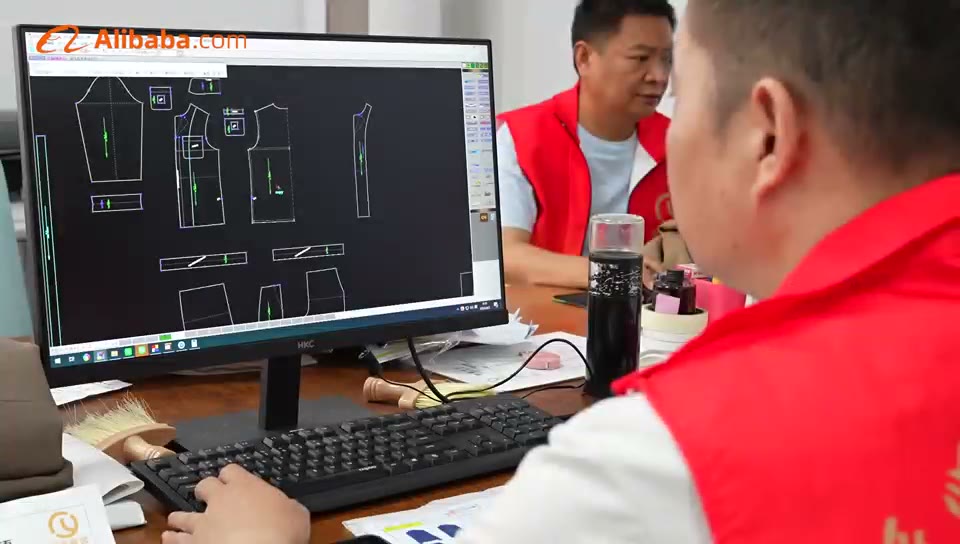
1. Four steps from sketch to pattern
- Block selection: choosing the block pattern by garment category (fitted dress block, relaxed drop-shoulder block and so on) — pick the wrong block and everything downstream goes crooked;
- Structure design: translating the sketch's silhouette into pattern pieces — fixing the darts, seam lines, pleats, placket and neckline construction;
- Net pattern to working pattern: adding seam allowance (commonly 1cm; 0.6–1cm on overlocked edges; 2.5–4cm at the hem depending on workmanship);
- Sample-revision loop: sewing the first sample → fitting it on a dress form or a model → correcting the pattern → usually finalised after 1–2 rounds.
Modern pattern rooms draft in CAD (the LIUYU CAD marker system appears in our video series), working to millimetre precision and linked to the downstream grading and marker-making software — far faster to revise than by hand.
2. Five details that reveal a pattern-maker's skill
- Shoulder, neck and armhole: on a good pattern the front armhole is scooped to just the right depth — no tightness raising the arm, no wrinkling with the arm down;
- Dart manipulation: on fitted styles the bust dart is transferred naturally and points accurately, rather than simply cut away as a triangle;
- Fabric matching: the same style should allow different ease in chiffon than in wool — asking a pattern-maker whether a style needs a knit block or a woven block instantly shows how deep their knowledge runs;
- Complete pattern set: lining, interlining, pocket bags and notches all present — a set missing pieces will inevitably cause errors on the factory floor;
- Revision records: every round of sample correction comes with a record of the pattern changes — what was changed and why, fully traceable.
3. Lead time and cost
A regular womenswear style patterns in 1–3 days; a complex outerwear piece takes 3–5 days. The pattern fee is usually charged together with the first-sample fee (RMB 300–800 per style), and crediting it once a repeat bulk order reaches the agreed quantity is a common arrangement. A revision round usually takes 1–3 days; most factories don't charge for small changes, while major structural re-drafting is billed separately.
If you remember one line from this stage: the sample is what the market sees, but the pattern is what the factory floor executes. The extra two days spent at the pattern stage save two weeks later in sewing and bulk production.